
Ομιλίες και Δημοσιεύσεις
Ομιλίες βίντεο και ήχος
ΒΟΞ: Η Αθηνά Πόταρη για την αυτογνωσία, την ελευθερία και την τέχνη του να ζεις ουσιαστικά
Vox: Athena Potari on Self-Knowledge, Freedom and the Art of Living Meaningfully (interview with Jenny Balatsinou)

Dr Athena D. Potari on Plato and Non-Duality
ΣΕΒΟΜΑΙ ΤΗΝ ΝΤΡΟΠΗ ΠΟΥ ΝΟΙΘΩ ΜΕΣΑ ΜΟΥ
Athena Despoina Potari: "I Respect the Shame I Feel Inside Me" (on eu zen, the good life)

Τι μας λέει σήμερα η Οδύσσεια για τον άνθρωπο
Athena Potari: What the Odyssey Tells Us About the Human Being Today: From Homer to the Journey of the Soul

The hidden Non-Duality in Ancient Greek Philosophy

Η αποχή από τα πολιτικά συνιστά πολιτική στάση
Athena D. Potari: Abstaining from Politics Is Itself a Political Stance

Αείζωον Πυρ, η Δικαιοσύνη και η Φιλοσοφία ως Εκπύρσωσις, Μέρος Β'
Ever-Living Fire, Justice, and Philosophy as Ekpyrosis (Part B)

Αείζωον Πυρ, η Δικαιοσύνη και η Φιλοσοφία ως Εκπύρσωσις, Μέρος Α'
Ever-Living Fire, Justice and Philosophy as Ekpyrosis (Part A)

Πώς η αληθινή Αγάπη και η Παιδεία θα φέρουν τη νέα συνειδησιακή επανάσταση (Β Μέρος)
Athena Potari: How True Love and Paideia Will Bring the New Revolution of Consciousness (Part 2)

Πώς ο Έρως οδηγεί στην πραγματική ευδαιμονία (Α Μέρος)
Athena Potari: How Eros Leads to True Eudaimonia and to the Higher Levels of Existence (Part A)

1ο Αρωματικό συμπόσιο ~ Η Ιερουργία του αρώματος
The Sense Seeks God: The Nature of the Senses according to Plato and the Sacred Rite of Aroma (1st Aromatic Symposium)

Τι Δεν Είναι και Τι Είναι Αφύπνιση ~ Η Θέαση του ΕΝΟΣ
What Awakening Is Not, and What It Is ~ The Beholding of the ONE

Ancient Greek Wisdom with Athena Potari

Από το Σκοτάδι στο Φώς, οι Ενεργειακές Πύλες των Ηλιοστασίων
From Darkness to Light: The Energy Gates of the Solstices and the Astronomy of the Soul

ΤΟ ΣΠΗΛΑΙΟ ΤΗΣ ΑΓΝΟΙΑΣ ΚΑΙ Η ΣΗΜΑΣΙΑ ΤΗΣ ΑΦΥΠΝΙΣΗΣ
The Cave of Ignorance and the Meaning of Awakening

KNOW THYSELF: Hellenic Philosophy as a Path to Awakening and Happiness

Απόλλων - Οι 5 αναβαθμοί της συνειδησιακής αφυπνήσεως
Apollo: The 5 Steps of the Awakening of Consciousness

Πυθαγόρας: Ο Μεγάλος Μύστης, Πρώτο Μάθημα
Pythagoras: The Great Initiate, First Lesson ~ Introduction to the Study Cycle in Hellenic Philosophy

Η Πλατωνική Παραβολή του Σπηλαίου: Εισαγωγή
Plato's Allegory of the Cave: Introduction

Ο Έρωτας ως Μονοπάτι Αφύπνισης σύμφωνα με την Σωκρατική Διδασκαλία
Eros as a Path of Awakening according to the Socratic Teaching

Τι Συμβολίζει το Αρχέτυπο του Θεού Άρη;
What Does the Archetype of the God Ares Symbolise? The Importance of Ares for Our Spiritual Path

Η Δεύτερη Γέννηση της Ψυχής, σύμφωνα με την Πλατωνική Φιλοσοφική Παράδοση
The Second Birth of the Soul, according to the Platonic Philosophical Tradition

Η έννοια της δεύτερης γέννησης του ανθρώπου σύμφωνα με την Πλατωνική φιλοσοφία
The Concept of Man's Second Birth According to Platonic Philosophy

ΤΙ ΕΣΤΙΝ ΕΛΛΗΝ; Φιλοσοφικά Διδάγματα του «ΟΧΙ»
What Is a Hellene? Philosophical Lessons of the "OXI" of 28 October

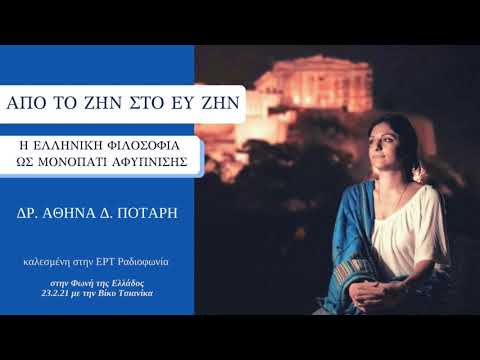
Από το Ζῆν στο Εὖ ζῆν: Η Ελληνική Φιλοσοφία ως Μονοπάτι Αφύπνισης (ΕΡΤ)
From Living (Zēn) to Living Well (Eu Zēn): Greek Philosophy as a Path of Awakening (ERT Radio interview)
The Art of Living - Dr Athena Potari

Άρθρα μελέτες, άρθρα και δοκίμια
The Light of Hellenism
Her longest public English essay, published 21 April 2021. She presents Hellenism as a civilization and spiritual path organised around Light, with philosophy and the sciences as disciplines of self-liberation. She argues that Logos is not discursive reasoning but the consciousness running through all things, close to the Indian Atma, so the split between a rational West and a spiritual East falls apart. Working through Diotima's ladder of love, Aristotle's self-thinking divine, Orphic theology and Plato's Sun analogy, she reads eros as the force by which Being goes out and returns, and truth as the light of Being. She ends by saying that Hellenes are, in spirit, those who have seen the Light, so Hellenism is a spiritual, universal identity and not an ethnic one.
Κύριες ιδέες
- Hellenism is at heart a path of 'En-lightenment', a culture built around realising Light.
- Logos means universal consciousness, beyond rule-based logic; logic is fulfilled in it, not discarded.
- The East and West divide is a myth: Hellenic thought grew in exchange with Egypt, Persia, Babylon and India (Pythagoras is her example).
- The sophist builds conceptual semblances without direct experience (Sophist 234c); the philosopher is an eros-struck seeker who is purified and sees.
- Diotima's ascent ends in a sudden vision of a Beauty that is also the Good and the Divine (Symposium 210d).
- Theoria is 'seeing the Divine'; Aristotle's God is self-aware thought that moves the cosmos as the beloved.
- In Orphic theology Eros, the 'appearer', rises from Chaos and turns the void into a sea of light; matter is denser light.
- Truth (aletheia) is the light of Being; AL, EL and ĒL name three grades of light, and eudaimonia follows when the illusion of separation burns away.
The illusion of East and West
A shorter version of 'The Light of Hellenism', written for a meditation readership. She notes that Hellenism is credited as the cradle of Western science, politics and democracy because of its commitment to reason, yet it took shape in constant exchange with Egyptian, Persian, Babylonian, Hindu and Buddhist wisdom. Read properly, its core notion of Logos is a consciousness pervading all things, so the opposition of a rational West and a spiritual East is an illusion, and philosophy is a lived path of self-transformation comparable to yoga or Advaita Vedanta. She closes with Diotima's path of love, theoria as seeing the divine, and Aristotle's prime mover that moves as the beloved, making creation an erotic going out and return of Being. This version leaves out the Orphic, Sun-analogy and AL/EL/ĒL sections of the original.
Κύριες ιδέες
- The divide between East and West is our own illusion; Western roots already contain awakening, purification and non-duality.
- Pythagoras learned in Egyptian schools and among Persian magi before teaching in Greece and southern Italy.
- Logos is closer to the Sanskrit atma than to rule-based reasoning: a state where personal awareness merges with universal awareness.
- Philosophy is a love affair with the divine; eros means merging and so dissolves separation.
- The seeker widens love step by step until it includes everything, and oneness is then recognised suddenly.
- Theoria, from 'theon oro', is seeing the Divine: nothing outside changes, only the veil of ignorance falls.
- Aristotle's divine is thought aware of itself that moves all things as the beloved, so the seeker's longing for oneness is Being's love of itself.
A Call for a Renaissance of the Spirit in the Humanities
A position paper she wrote on behalf of the Galileo Commission, extending the 2014 Manifesto for a Post-Materialist Science and the 2018 Galileo Commission Report to the Humanities. It opens with Plotinus's question of who we are, then diagnoses a materialist worldview, in which matter is primary and consciousness a by-product of the brain, that has spread from the sciences into the Humanities, which she says began as a way of tending the human spirit. She traces its costs: an academic monoculture, discrimination against intuitive and contemplative knowing, a 'divided life' for scholars who hide non-materialist experiences, and social and ecological harm. The Call asks the Humanities to take seriously evidence that consciousness is primary and unified, to admit contemplative and participatory ways of knowing, to rejoin theory and practice, and to return to Hellenic and other wisdom traditions. A 2023 circulation of the Call reported more than 100 scholarly signatories.
Κύριες ιδέες
- Plotinus's 'who are we?' (Enneads VI.4) frames the whole Call.
- Since the 17th century a mechanistic, materialist worldview has treated consciousness as a by-product of matter, which in her view undermines free will, meaning and moral responsibility.
- The Humanities began as a way of curating the spiritual and intangible side of human life; losing that purpose cost them their standing.
- Scientism, materialism as ideology, treats science as the only valid knowledge.
- Academia favours left-hemisphere, linear and empirical approaches over intuition and imagination (citing McGilchrist); she links this to patriarchal residues and calls for feminine epistemologies.
- The 'divided life': scholars keep non-materialist views private for fear of professional rejection.
- Heraclitus's shared Logos, gnosis as consciousness turning on itself, and the Delphic 'know thyself' should return to academic life.
- Experiences of oneness carry ethical weight, grounding care for others, life and the earth.
Know Thyself: Hellenic Philosophy as a Path to Awakening and Happiness
A short text of about 350 words, published 11 February 2023, that sets out the theme of her talk. It credits Pythagoras with first using the word 'philosophy' after some 35 years of training in Egyptian and Babylonian esoteric schools, possibly also in India. She describes his synthesis of Orphic theology, with its devotional and ethical side, and the Presocratics' new reasoning about nature (sophia). The resulting 'Philo-Sophia' joins science and spirituality in order to awaken consciousness to our true nature, which she names as oneness and happiness. Against the long habit of treating philosophy as rational argument, she presents it as a self-transforming path of self-inquiry that trains both heart and mind.
Κύριες ιδέες
- Pythagoras, a 6th-century BCE sage, was the first to call himself a lover of wisdom.
- He trained for about 35 years in Egyptian and Babylonian esoteric schools, perhaps also in India, before returning as a teacher and reformer.
- Philosophy fuses Orphic devotion and ethics with sophia, the reasoned knowledge of nature.
- The aim is to awaken consciousness to our true nature, which is oneness and happiness.
- Philosophy is essentially a spiritual, self-transforming practice, not only an academic discipline.
- Ancient philosophers used psychological and spiritual tools and taught non-dual views that matter for seekers today.
From the Faculty: Conversation with Athena Potari. On the Revival of the Humanities as a Living Practice
A written conversation published 5 January 2026 with Embodied Philosophy founder Jacob Kyle, ahead of the Wisdom School where she teaches the Hellenic Pathway. She traces the humanities to the Greek passage from the Presocratics, whom she sees as mystics and priests speaking from expanded states of consciousness, to Socrates, who turned that inquiry toward the soul, ethics and life in the agora. Because the human is a microcosm of the cosmos, studying oneself is also studying the universe, and the humanities were meant to ground spiritual knowledge in personal and civic life. Today, she argues, they keep the skeleton but have lost the 'humus', the juice of imagination, contemplation, poetry and spirit, as materialism spread from science. Following Aristotle she names eudaimonia as the telos of life and of the humanities, reached through self-knowledge, and hopes Wisdom School can point toward a future 'Wisdom University'.
Κύριες ιδέες
- The humanities are a Western project born at the turn from the Presocratics to Socrates.
- The Presocratics were less early scientists than mystics and priests drawing on expanded consciousness.
- Socrates made an anthropocentric turn toward soul, ethics, habit and civic life; she suggests he was initiated into the Eleusinian Mysteries.
- The human is a microcosm of the cosmos, so self-knowledge opens onto knowledge of the universe.
- The humanities should ground spiritual and esoteric knowledge in daily and civic life, as a technology of becoming.
- Modern humanities keep the skeleton but have lost the humus; funding falls because few now believe in soul or spirit.
- Following Aristotle, eudaimonia is the telos: learning becomes knowing oneself, and knowing becomes a way of being.
- Universities skip self-knowledge because they assume we are only bodies, a bleak premise in her view.
Αθηνά Δέσποινα Πόταρη: «Αυτή η Εποχή κυοφορεί την Αφύπνιση της Ανθρωπότητας»
Athena Despoina Potari: 'This Era Is Gestating the Awakening of Humanity'
A short Greek article from 5 April 2021 that quotes her radio interview on ERT's satellite station Voice of Greece, with the audio embedded. She recognises the real hardship of the pandemic year but argues that crises have always been the most fertile ground for the seed of change, and that this global crisis is a chance to raise consciousness and humanism, with Greece having a large part to play. Asked how the locked door to the inner world opens, she says it opens like anything else: through attention, whether to an idea or to the heart of someone we love, and through a personal turning around. She recalls Socrates in the Republic defining paideia as the soul's turning from appearances toward truth, light and being, and treats eudaimonia, the ground for fulfilling human entelechy, as an inner matter.
Κύριες ιδέες
- Crises are the most fertile soil for the seed of change; transformation follows crisis.
- The pandemic, being global, is an opportunity to raise consciousness and humanism everywhere, Greece included.
- The door to the inner world opens through attention and through a personal turning around.
- Paideia, in Socrates' words, is the turning of the soul from appearances toward truth, light and being.
- The era has sped up our shift of attention from outer events to the inner world.
- Eudaimonia is an inner matter and the basis for fulfilling human entelechy; mere living can become living well.
Η ΡΟΗ ΩΣ ΠΟΛΙΤΙΚΗ: Ψυχικές και πολιτικές διαστάσεις του Ηρακλείτειου Λόγου
The Flow as Political: Psychological and Political Dimensions of the Heraclitean Logos
A 12-page Greek conference paper, written under her University of Oxford affiliation, that follows the idea of flow from Heraclitus's cosmology through the soul to ethics and politics. The One is a single undivided whole that plays itself out as the cosmos, like Heraclitus's child at play; opposition and division belong to the mind, whose projections can harden into self-made prisons or 'caves'. Flow, which she ties to Eros and to a triad of Love, Wisdom and Truth acting as one, is how the One appears as all things while staying one. Using Socrates' etymologies in the Cratylus, she reads virtue as the soul's free, unobstructed flow and the shameful as what holds it back, so ethics becomes the bridge between cosmos and city. With Aristotle she sets collective eudaimonia as the aim of politics, aligning human law with natural law, so that Heraclitus's pair of cosmic unity and truth becomes the political pair of universality and freedom.
Κύριες ιδέες
- The wise acknowledge that all things are one (fr. 50); reaching the limits of the mind is a sign of philosophical maturity.
- Opposites are masks of one dynamic unity; division belongs to the mind, not to being.
- The One is like a child at play (fr. 52) and rests by changing (fr. 84).
- Flow (rhoe) is the principle that lets the One appear as many; she reads Eros as 'es-rheon', flowing inward.
- Love, Wisdom and Truth act together as one triad.
- Virtue is the soul flowing freely and unobstructed (Cratylus 415d); the shameful is what blocks the flow (416b).
- Politics aims at collective eudaimonia, aligning the polis and human law with the cosmic and natural order (fr. 114).
- Cosmic unity and truth become universality and freedom in politics; union is both the origin and the aim of common life.
Power in political thought: a comparative conceptual morphology
Her Oxford doctoral thesis in political theory, listed under 'Potari, D' with Michael Freeden as supervisor and funding from the Propondis Foundation. Only the abstract and record could be read here: the full PDF is listed as downloadable on ORA but could not be fetched. The abstract says the thesis tries to renew interest in power as a concept in political theory by looking at how different ways of thinking about power shape its definitions, and at the cognitive, ideational and linguistic micro-processes behind them. It uses a hermeneutic method combining conceptual morphology, intellectual history and interdisciplinary study, along two axes: cultural history, centred on Aristotle's dunamis as the first conceptual form of power in political thought, and interdisciplinarity, tracing force in physics and its parallel in political thought.
Κύριες ιδέες
- Power is under-examined in its discursive dimensions; the thesis aims to revive interest in it.
- Ways of thinking about power shape how it is defined and theorised.
- A hermeneutic approach joins morphology, intellectual history and interdisciplinary study.
- Aristotle's dunamis is treated as the original conceptual mode of power in political thought.
- The physics of force is read alongside its parallel development in political thought.
Η Ερμηνευτική της Δυνάμεως. Η Αριστοτελική έννοια της Δυνάμεως και η Πολιτική της Σημασία
The Hermeneutics of Dynamis: The Aristotelian Concept of Dynamis and Its Political Significance
Known only from the Academy of Athens 2020 award list, which names Despoina Potari as winner of the Evangelos and Michel Moutsopoulos Philosophy Prize (3,000 euros) for this unpublished scientific study. Her bios refer to this as the Academy of Athens Award of Philosophy (2020), and the Galileo Commission bio says she was the youngest woman to receive it. The text itself is not available. From its title, it shares the Aristotle and dunamis theme of her Oxford thesis.
The Metaphysical Grounds of Anthropology and Morality in Neoplatonic Proclus
A journal article co-written with Christos Terezis (University of Patras), listed on her academia.edu profile and cited in full in the bibliography of her Heraclitus paper. No abstract or full text could be found online, so its content is not summarised here. Note that a similarly titled Greek article on Proclus in Parnassos (2001) is by Terezis and Kalomoira Polychronopoulou, not by her.